| Vanilla Orchid (Vanilla planifolia) The orchid family (Orchidaceae) is the second largest family of flowering plants with approximately 20,000 species. Some estimates for the size of this family are higher, but the sunflower family (Asteraceae) is now considered the largest with nearly 24,000 species. With the exception of numerous varieties of exquisitely beautiful blossoms which are sold commercially, the only economically important product in this great plant family is the delicious spice known as vanilla. Vanilla comes from several species of perennial vines of the genus Vanilla native to Mexico and tropical America. The vines commonly climb on the trunks of trees or poles by means of adventitious (aerial) roots. The primary source of commercial vanilla comes from V. planifolia, also listed in many references as V. fragrans. Another lesser known species is West Indian vanilla (V. pompona). The Aztecs originally used vanilla as a flavoring for chocolate, and the Spanish conquerers carried it back to Europe where it was used for this same purpose. 
Vanilla extract is obtained from the unopened seed capsules (called vanilla beans) which superficially resemble bean pods. The unopened pods are picked when the color changes from green to yellow. The pods are placed in the sun for up to five hours, then they are tightly wrapped in blankets and placed in airtight boxes to sweat. This process is repeated for up to 36 days. During this curing process the pods undergo fermentation and turn black in color. After the laborious curing process, the pods are thoroughly dried. The long fermentation process causes several glucosides (including glucovanillin) to decompose into glucose and vanillin. Vanillin is the aromatic phenolic compound which produces the characteristic aroma and flavor of vanilla . It is extracted from chopped up vanilla beans in an ethanol-water mixture to yield the vanilla extract of commerce. Vanillin is also synthesized from other compounds, such as eugenol from oil of cloves, and as a by-product from the breakdown of lignin in the manufacture of paper from wood pulp. Extracts of vanillin derived from sources other than vanilla beans are usually labeled "imitation vanilla." Vanilla bean extract is more expensive, but has a better flavor than imitation vanilla. According to the excellent recommended text for this course (Economic Botany by B.B. Simpson and M.C. Ogarzaly (1995), an American biotechnology firm has developed a method of obtaining vanilla by culturing plant cells. This technology could greatly reduce the cost of growing vanilla beans, but could seriously effect the economy of vanilla-producing countries such as Madagascar, Java and Tahiti. According to many chefs, bakers and vanilla connoisseurs, the best flavoring comes directly from the vanilla pods. They would never use imitation vanilla extract in their favorite recipes. There are apparently subtle ingredients in the real vanilla bean that truly enhance the flavor. Small pieces of the pulpy pod are added to various dishes and pastries for their unique flavoring. Also embedded in the pulpy pods are thousands of minute seeds. The tiny brown or black specks in vanilla ice cream indicate that real vanilla beans were used; however, similar specks from another source could be used in imitation ice creams. As a flavoring for cream-filled chocolates, toppings, beverages, cookies, cakes, pies, puddings and ice creams, vanilla is unsurpassed. Vanilla extract adds a delicious fragrance to candles, creams, perfumes and lotions. It is also used pharmaceutically for flavorings in medicines, and to treat loss of appetite. Many species of orchids have showy, intricately-shaped flowers that require special pollinators, and the vanilla orchid is no exception. Throughout the tropical regions where this remarkable orchid is cultivated, including Madagascar, Seychelles Islands, Java and Polynesia, the flowers are always pollinated by hand. Even in its native habitat of Mexico, cultivated orchids are pollinated by hand since natural pollination occurs in less than one percent of the blossoms. It has been postulated that hand pollination was also practiced by the Aztecs in order to maintain the populations of these remarkable orchids. The inflorescence (raceme) bears 20 or more flowers which open in succession, each flower lasting one day. Hand pollination involves the pressing of pollen masses (pollinia) into the stigmas of flowers. Entire vanilla plantations must be hand-pollinated every morning during the blooming season, and a trained pollinator can transfer pollen to 1,500 flowers per day.
|
Tuesday, August 31, 2010
Vanilla Orchid
 *
* *
*
Sunday, August 29, 2010
Orchids and Insects
The orchid family could have died out like dinosaurs if insects had chosen to feed on simpler plants and not on orchids. The orchids wouldn't have been pollinated, and without pollination they would never have grown seeds, while self–pollinating simple plants growing nearby would have seeded themselves constantly and spread like mad and taken up more and more space and light and water, and eventually orchids would have been pushed to the margins of evolution and disappeared. Instead, orchids have multiplied and diversified and become the biggest flowering plant family on Earth because each orchid species has made itself irresistible. Many species look so much like their favorite insects that the insect mistakes them for kin, and when it lands on the flower to visit, pollen sticks to its body. When the insect repeats the mistake on another orchid, the pollen from the first flower gets deposited on the stigma of the second—in other words, the orchid gets fertilized because it is smarter than the bug. Another orchid species imitates the shape of something that a pollinating insect likes to kill. Botanists call this pseudoantagonism. The insect sees its enemy and attacks it—that is, it attacks the orchid—and in the process of this pointless fight the insect gets dusted with orchid pollen and spreads the pollen when it repeats the mistake. Over the eons, orchids have bent over backward coming up with new tricks to entice insects. This orchid,Renathera storiei, a native of the Philippines, relies on a red so rich it seems dabbed on. Enlarge Photo credit: ©Kevin Schafer/CORBIS Other species look like the mate of their pollinator, so the bug tries to mate with one orchid and then another—pseudocopulation—and spreads pollen from flower to flower each hopeless time. Lady's slipper orchids have a special hinged lip that traps bees and forces them to pass through sticky threads of pollen as they struggle to escape through the back of the plant. Another orchid secretes nectar that attracts small insects. As the insects lick the nectar they are slowly lured into a narrowed tube inside the orchid until their heads are directly beneath the crest of the flower's rostellum [an extension of the stigma, the part of a flower on which pollen germinates]. When the insects raise their heads the crest shoots out little darts of pollen that are instantly and firmly cemented to the insects' eyeballs but then fall off the moment the insects put their heads inside another orchid plant. Some orchids have straight–ahead good looks but have deceptive and seductive odors. There are orchids that smell like rotting meat, which insects happen to like. Another orchid smells like chocolate. Another smells like an angel food cake. Several mimic the scent of other flowers that are more popular with insects than they are. Some release perfume only at night to attract nocturnal moths. No one knows whether orchids evolved to complement insects or whether the orchids evolved first, or whether somehow these two life forms evolved simultaneously, which might explain how two totally different living things came to depend on each other. The harmony between an orchid and its pollinator is so perfect that it is kind of eerie. Darwin was very interested in how orchids released pollen. He experimented by poking them with needles, camel–hair brushes, bristles, pencils, and his fingers. He discovered that parts were so sensitive that they released pollen upon the slightest touch, but that "moderate degrees of violence" on the less sensitive parts had no effect, which he concluded meant that the orchid wouldn't release pollen haphazardly—it was smart enough to save it for only the most favorable encounters with bugs. He wrote: "Orchids appeared to have been modelled in the wildest caprice, but this is no doubt due to our ignorance of their requirements and conditions of life. Why do Orchids have so many perfect contrivances for their fertilization? I am sure that many other plants offer analogous adaptations of high perfection; but it seems that they are really more numerous and perfect with the Orchideae than with most other plants." The schemes that orchids use to attract a pollinator are elegant but low–percentage. Botanists recently studied 1,000 wild orchids for 15 years, and during that time only 23 plants were pollinated. The odds are bad, but orchids compensate. If they are ever fertilized, they will grow a seedpod that is supercharged. Most other species of flowers produce only 20 or so seeds at a time, while orchid pods may be filled with millions and millions of tiny dust–sized seeds. One pod has enough seeds to supply the world's prom corsages for the rest of eternity. Some species of orchids grow in the ground and others don't live in soil at all. The ones that don't grow in soil are called epiphytes, and they live their lives attached to a tree branch or a rock. Epiphytic orchid seeds settle in a comfortable spot, sprout, grow, dangle their roots in the air, and live a lazy life absorbing rainwater and decayed leaves and light. They aren't parasites—they give nothing to the tree and get nothing from it except a good place to sit. Who needs earth when you have air? This epiphytic orchid, Paphiopedilum esquirolei, lives high in trees found in northern Thailand and southern China. Enlarge Photo credit: ©Greg Allikas Most epiphytes evolved in tropical jungles, where there are so many living things competing for room on the jungle floor that most species lose the fight and die out. Orchids thrived in the jungle because they developed the ability to live on air rather than soil and positioned themselves where they were sure to get light and water—high above the rest of the plants on the branches of trees. They thrived because they took themselves out of competition. If all of this makes orchids seem smart—well, they do seem smart. There is something clever and unplantlike about their determination to survive and their knack for useful deception and their genius for seducing human beings for hundreds and hundreds of yearsA Plant With Smarts
Bamboozling bugs

The harmony between an orchid and its pollinator is so perfect that it is kind of eerie.
Flower power
One orchid pod has enough seeds to supply the world's prom corsages for the rest of eternity.

Saturday, August 28, 2010
exotic orchids
Exotic Wild orchids

The book moves on to the various foreign orchids Darwin had received from others. His experiments showed that the "astonishing length" of the 11½ inch (290 mm) long nectary hanging from Angraecum sesquipedale flowers implied the need for an as yet unknown moth with a proboscis 10–11 inches (250–275 mm) long to pollinate these flowers in Madagascar. He viewed this as the outcome of a coevolutionary race, writing that "there has been a race in gaining length between the nectary of the Angræcum and the proboscis of certain moths".[63][64] This wastefulness is familiar in modern terms as the idea of an evolutionary arms race, but was disturbing to biologists of the time who believed that adaptations were the outcome of benevolent divine purpose.[65]
Darwin described "the most remarkable of all Orchids", Catasetum, and showed how in these flowers, "as throughout nature, pre-existing structures and capacities [had been] utilised for new purposes". He explained the mechanism in which the pollen masses of the pollinium were connected by a bent stalk or pedicel to a sticky disc kept moist at the back of the flower. When an insect touched an "antenna" projecting from the back of the flower, this released the bent pedicel which sprang straight and fired the pollinium, sticky disc first, at the insect. In experiments, Darwin had imitated this action using a whalebone spring. He vividly illustrated how the flower ejected the pollinium with considerable force: "I touched the antennæ of C. callosum whilst holding the flower at about a yard's distance from the window, and the pollinium hit the pane of glass, and adhered to the smooth vertical surface by its adhesive disc."[66]
Friday, August 27, 2010
Orchids Through Darwin's Eyes
Orchid information 


via www.mnh.si.edu on 8/27/10
Charles Darwin used orchids to help prove his theories of natural selection and evolution. Scientists today follow in Darwin’s footsteps and use orchids to learn more about how plants have evolved and adapted to live in almost every type of environment around the world.
In Orchids through Darwin’s Eyes, we explore the alluring world of orchids from the perspective of Darwin and the naturalists, horticulturists, and scientists he influenced. Along with thousands of colorful, fragrant, live orchids, a highlight of this exhibition is the earliest orchid fossil, embedded in amber with an extinct bee species.
Drawing of Charles Darwin
Courtesy Wellcome Library, London
Courtesy Wellcome Library, London
Darwin and Orchids
Charles Darwin’s careful observations of animals, plants, and geological formations inspired his speculations about how species adapt to their environments. When he published On the Origin of Species in 1859, some critics said he did not support his theory of natural selection with enough evidence.
“In my examination of Orchids, hardly any fact has so much struck me as the endless diversity of structure...for gaining the very same end, namely, the fertilisation of one flower by the pollen of another.”
—Charles Darwin, On the various contrivances by which British and foreign orchids are fertilised by insects, 1862
Darwin agreed that further research was needed, and chose to study the elaborate adaptations found in orchid flowers. In his 1862 book, On the various contrivances by which British and foreign orchids are fertilised by insects, Darwin carefully described his observations of orchid pollination and how orchid flowers had evolved to attract certain pollinating insects. He concluded that different orchid species had evolved strategies to ensure cross-pollination, which greatly benefits the species by producing greater numbers of viable seeds and stronger seedlings.
Modern Research
Catasetum sp.
Illustration by Kim Moeller
Illustration by Kim Moeller
Darwin’s theories and research have become the foundation of modern biological science. And research on orchid evolution continues still. Orchids through Darwin’s Eyes introduces visitors to some of the current research on orchid evolution from around the world.
“It makes no common sense for male Catasetum flowers to mistreat their pollinators, but it makes perfect evolutionary sense….it is advantageous for the male flower to somehow deter other male flowers from being visited by the same bee.”
—Dr. Daniel Fulop, Harvard University
Fossilized orchid pollen
and bee embedded in amber.
Courtesy of Santiago Ramírez
and bee embedded in amber.
Courtesy of Santiago Ramírez
“…the orchid family was fairly young at the time of the extinction of the dinosaurs some 65 million years ago and began to flourish shortly thereafter.”
—Dr. Santiago Ramírez, University of California, Berkeley
Creating the Orchids Exhibition
Smithsonian Horticulture and Office of Exhibits Central staff installing Orchids through Darwin's Eyes. Photos by Angela Roberts, Smithsonian Institutio
Thursday, August 26, 2010
Orchidales
Orchidales
Orchids and their kin

Some more good Orchid Information:
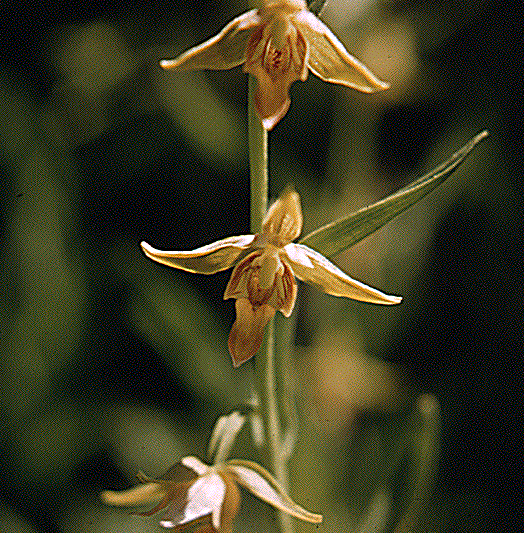
The Orchidales include the orchids and three smaller families. Together, they are one of the largest groups of plants, although they are not of particular ecological or economic importance. Vanilla is cultivated for the strong flavor of its fruits; the little black specks in vanilla ice cream are actually the seeds from the orchid. Many kinds of orchids are cultivated and bred for their delicate and often bizarre flowers. The orchid pictured at right above is Phalaenopsis McLellans, a commonly cultivated genus. On the left is Epipactis gigantea, a native California orchid. see also orchid types, orchid lights, wedding orchids, water orchids, growing orchids indoors, orchid propagation, orchids to buy, orchids repotting, caring for orchids.
Unlike their closest relatives, most orchids have only a single large stamen attached to the pistil to form the gynostemium, visible in the center of an orchid flower. The flowers are bilaterally symmetrical, a necessity for reliable pollination by bees. Many tropical species of orchid will rely on a single species of euglossine bee to pollinate them, and the bee will visit only that particular species of orchid which its kind pollinates. Because of this, the orchid must ensure that its pollen is properly delivered. This is most often achieved by gluing the whole supply of pollen to the visiting bee in a mass called the pollinia. When the bee visits another orchid of the same species, thousands of pollen grains are delivered, allowing the plant to mature thousands of tiny dust-like seeds.
The first orchids were large terrestrial plants, but like bromeliads, orchids took to the trees, where they have diversified to become the largest family of flowering plants. They are able to survive in the treetops in part because many species form mycorrhizal associations with fungi. The fungi increase the area over which the orchid can acquire nutients and water, while the orchid provides food to the fungus which it makes by photosynthesis.
Because orchids are primarily tropical epiphytes and small herbs, they do not have a fossil record. However, like palms and some members of the Iridales, they have plicate (corrugated) leaves, and these leaf forms are among the earliest known fossil monocots.
The Orchidales may be divided into the following families:
- Burmanniaceae
Thismiaceae
Corsiaceae
Orchidaceae - the orchids
- Apostasioideae - Apostasia and Neuwiedia
Cypripedoideae - lady's slippers (4 genera)
Orchidoideae - most orchids (750 genera)
The first three families are sometimes put into another order, the Burmanniales, but are still considered the closest relatives of the Orchidaceae, so this separation is largely a matter of opinion. The Orchidales have traditionally been considered the "pinnacle" of monocot evolution, and so are listed last in many floras. This view does not reflect any biologically meaningful information, and so has been abandoned.
Wednesday, August 25, 2010
Orchid Types - Orchid fertilization
Fertilisation of Orchids is a book by Charles Darwin published on 15 May 1862 under the full explanatory title On the various contrivances by which British and foreign orchids are fertilised by insects, and on the good effects of intercrossing.[
The book was his first detailed demonstration of the power of natural selection, and explained how complexecological relationships resulted in the coevolution of orchids and insects. The view has been expressed that the book led directly or indirectly to all modern work on coevolution and the evolution of extreme specialisation. It influenced botanists, and revived interest in the neglected idea that insects played a part inpollinating flowers. It opened up the new study areas of pollination research and reproductive ecology, directly related to Darwin's ideas on evolution, and supported his view that natural selection led to a variety of forms through the important benefits achieved by cross-fertilisation. Although the general public showed less interest and sales of the book were low, it established Darwin as a leading botanist. Orchids was the first in a series of books on his innovative investigations into plants.
The book describes how the relationship between insects and plants resulted in the beautiful and complex forms which natural theology attributed to a grand designer. By showing how practical adaptations develop from cumulative minor variations of parts of the flowers to suit new purposes, Darwin countered the prevailing view that beautiful organisms were the handiwork of a Creator. Darwin's painstaking observations, experiments, and detailed dissection of the flowers, explained previously unknown features, such as the puzzle of Catasetum which had been thought to have three completely different species of flowers on the same plant, and produced testable predictions. His proposal that the long nectary of Angraecum sesquipedale meant that there must be a moth with an equally long proboscis was controversial at the time, but was confirmed in 1903 when Xanthopan morgani praedicta was found in Madagascar.
Fertilisation_of_Orchids_1877_edition_title_page.jpg (2872×4760)
| darwin |
From Evernote: |
Fertilisation_of_Orchids_1877_edition_title_page.jpg (2872×4760)Clipped from: |

Monday, August 23, 2010
Orchid Information
Here is some interesting Orchid Information from Wikipedea:
Orchidaceae, commonly referred to as the Orchid family, is a morphologically diverse and widespread family of monocots. It is currently believed to be the second largest family of flowering plants (only the Asteraceae is larger), with between 21,950 and 26,049 currently accepted species, found in 880 genera. The number of orchid species equals more than twice the number of bird species, and about four times the number of mammal species. It also encompasses about 6–11% of all seed plants. The largest genera are Bulbophyllum (2,000 species),Epidendrum (1,500 species), Dendrobium (1,400 species) and Pleurothallis (1,000 species).
Subscribe to:
Comments (Atom)